♥
Compassion Lab

Welcome back — here's your lesson, ready to go.

Teacher Guide

Materials

  • Loris Opens Up His Heart (book or reading video)
  • Screen or projector
  • Whiteboard (optional)

Before you start (1 min)

  1. Open this page on your classroom screen.
  2. Have the book or reading video ready.
  3. Gather students where they can see the illustrations.

Helpful tips

  • There are no wrong interpretations — ask for story evidence.
  • Ask students to support their interpretations with clues from the story.
  • Encourage more than one plausible explanation.
  • Distinguish what students observe from what they assume.
  • Do not immediately confirm one interpretation as correct.
  • Encourage students to explain possible consequences of their suggested responses.
  • Respect students who prefer not to share personal experiences; let them pass.
  • If a student shares something concerning, follow your school's support process.

Why we use Before & After activities

These two activities present different but comparable fictional social situations. Students respond to the first before exploring Loris's story and the second afterward. The goal is to observe whether students begin considering different perspectives, questioning assumptions, and proposing more thoughtful responses.

These are informal classroom observations, not formal measures of emotional development.

Before & After: Classroom Learning Check

These two activities help students question first impressions, separate facts from assumptions, and explain thoughtful responses.

Complete the BEFORE activity → Teach Loris's story → Complete the AFTER activity.

01 — BEFORE THE STORY

The Photo Nobody Mentioned

Scenario A · Mateo

2 minutes

Complete this activity before introducing Loris.

View ActivityPrint

02 — AFTER THE STORY

The Lunch Table

Scenario B · Maya

2 minutes

Complete this activity after the Loris story.

View ActivityPrint
How to Use the Learning Checks
  • Display or print each scenario, read it aloud, and ask its three open-ended questions. Students may respond aloud or in writing; no student accounts or submissions are required.
  • The two situations are different but comparable. Allow approximately the same discussion time for both (about 2 minutes each).
  • Accept different plausible interpretations without suggesting correct answers or revealing why a character acted that way.
  • Look for evidence of students: considering more than one explanation; distinguishing facts from assumptions; recognizing that someone's intentions and their impact may differ; suggesting thoughtful rather than impulsive responses; and explaining their choices rather than naming a "correct" answer.
  • No scoring or grading. Do not collect or submit identifiable student answers.
  • These are informal teacher observations, not proof of learning gains.
  • The activities may be completed on different days.

Optional extension · Create Your Own Response

If time allows, invite students to write, draw, or role-play a short conversation showing how Mateo or Maya could respond. Ask them to explain why they chose that response and what might happen next. This is optional and not part of the 15-minute lesson.

The activities are optional for ordinary classroom use. Teachers participating in the before-and-after evaluation should complete both in the correct order.

Interactive Story Lesson · 15 minutes

Begin the Loris story after completing the BEFORE activity.

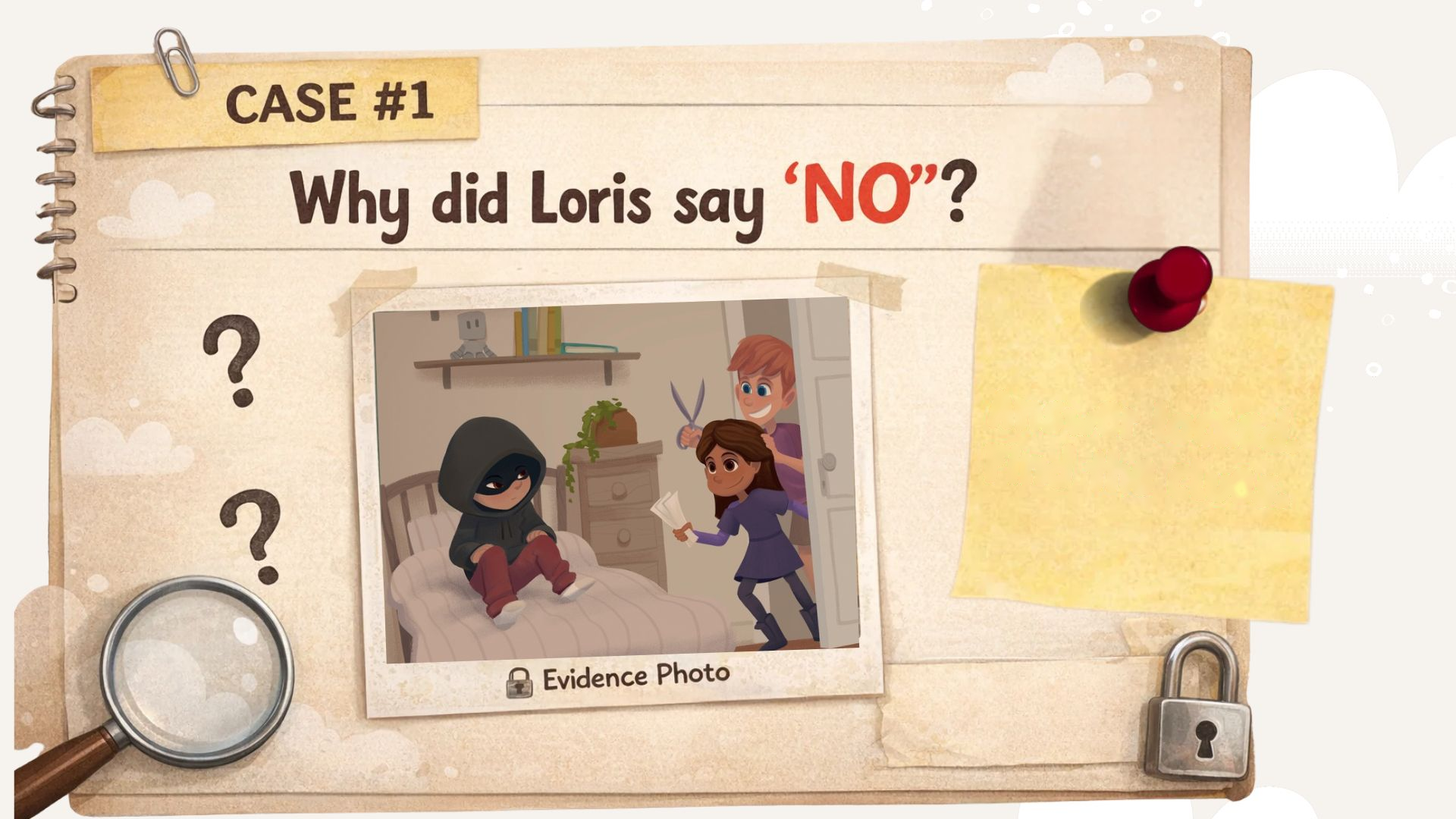
Case #1: Why did Loris say 'NO'? — original webinar slide with the evidence photo of Loris on his bed as two children peek through the door, from Loris Opens Up His Heart

Case open.
Follow the clues.

Featured lesson · Grades 4–6 · Ages 9–12

Emotion Detectives: Why Does Loris Say NO?

Objectives

Students investigate why people sometimes behave differently from how they feel, distinguish facts from assumptions, consider multiple perspectives, and develop thoughtful responses.

  • Reading comprehension and evidence-based inference
  • Recognizing complex and conflicting emotions
  • Distinguishing observations from assumptions
  • Understanding different motivations and perspectives
  • Considering the consequences of different responses
  • Creating and explaining thoughtful responses to social situations

Duration

≈15 minutes

Timings are adjustable

Progress

1 / 4 (25%)

Step 1 of 4 · 4 min

Meet Loris

Your First Detective Challenge!

Loris wearing his dark hoodie and holding a red heart against an orange background

Does Loris look friendly to you? Why or why not?

What assumptions might we make about someone based on how they look?

Teacher tip · Before the video · ≈1 minute
Invite two quick interpretations. Do not correct students immediately. Don't reveal Loris's story yet—we'll return to this question later.

Watch Loris's Story

As you listen, notice the moments when Loris says NO. What might be happening beneath his words?

During the video · ≈3 minutes
Play the story reading. Ask students to notice each NO.

After the video
Ask: “What have we learned about Loris that we couldn't tell from his appearance?” Help students distinguish first impressions from information revealed in the story.

Prototype for customer validation · Original artwork and reading video from Loris Opens Up His Heart · Referral section uses sample data · No student data is collected